Standalone work
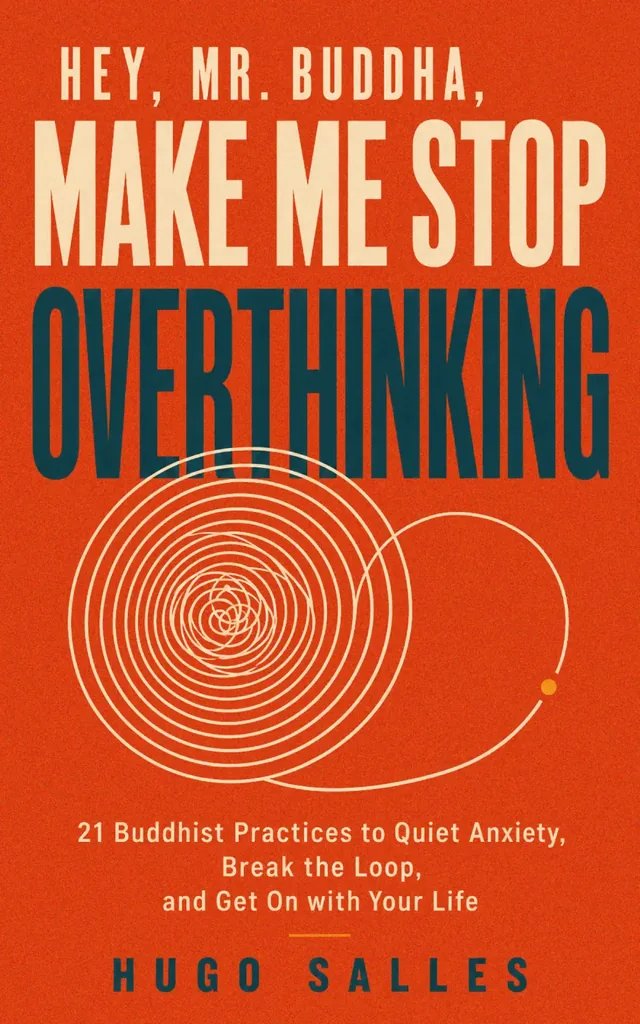
Hey Mr. Buddha, Make Me Stop Overthinking
21 Buddhist practices to quiet anxiety, break the loop, and get on with your life.
About the book
Your mind convenes a committee at 2 a.m. This book is the adjournment procedure.
You replay a conversation from three years ago. You draft the message you will never send, revise it forty times, and deliver it to nobody — in the car. You research a decision for five weeks and somehow know less than when you started. And everyone keeps telling you to “let it go”, as if you hadn't thought of that. As if thinking were the problem.
Here is the part nobody told you: the Buddha left a protocol for this. Not a vibe. Not a poster. An actual, sequential, five-step procedure for what to do when a thought will not leave — plus twenty other practices for the loop, the worry, the grudge, the guilt, and the decision you keep not making.
Every one of the 21 practices comes with a named source: a specific discourse or classical manual you can read tonight, free, with the book showing you exactly where. And every one comes with exact instructions — what to do, how long to do it, and what it feels like when it starts working. No “sit with it”. No “observe without judgment” and good luck.
This is not a book about emptying your mind, escaping your life, or becoming permanently calm. It is about recognizing the loop, interrupting it, and getting back to what you were doing. Practical Buddhism for 2 a.m., for traffic, for the difficult conversation, and for every case your mind insists on reopening.
Who this book is for
- Readers whose mind reopens closed cases at two in the morning
- Anyone who replays old conversations and rehearses future ones
- Readers who tried meditating and quit believing they “can't stop thinking”
- Anyone tired of being told to “just let it go”
- Readers who want a named source and exact steps, not vibes
What you will find inside
- The five-step procedure for a thought that will not leave
- 21 standalone practices, each written for a specific kind of loop
- A named source for every practice — a discourse or classical manual you can read yourself
- Exact instructions: what to do, how long, and what it feels like when it works
- What to do with rumination, worry, resentment, guilt and the decision you keep postponing
From the book
“It was a Thursday, and Clara had spent thirty minutes improving a conversation with her ex — a conversation that had ended four days earlier and was somehow still receiving updates. She got up to deal with the sink. Washed the bowl. Washed the pan. Became strangely interested in a stain on the bottom of the pan. Four minutes in, she noticed her ex had left the building. Not because she won, and not because she settled anything. He was evicted by a saucepan.
So the Buddha calls in a carpenter: a skilled carpenter knocks a coarse peg out of a hole by driving a finer one into the same spot. No struggle, no acceptance, no leaf floating down a river, no music in the background. There is a hole with a peg in it, and to get one out you drive another in. How many holes does attention have? One. That is very bad news for the committee.⬝
Frequently asked questions
Do I need to meditate to use the practices?
No. Several practices work standing up, in traffic, or in the middle of a meeting. Formal meditation is an option, not a prerequisite.
Is this book part of The Technologies of the Awakened Mind?
No. It is a standalone work, more direct and funnier, though it shares the same approach: method before doctrine.
Can I read it out of order?
Yes, and that is how it was written. Each of the 21 practices is self-contained, has its own named source and its own instructions; go straight to the one that matches your kind of loop.
Does it replace therapy?
No. The book offers contemplative practices for everyday life and is not a substitute for mental health treatment.
Start reading today
Available in English and Portuguese, on Amazon and Kindle Unlimited.